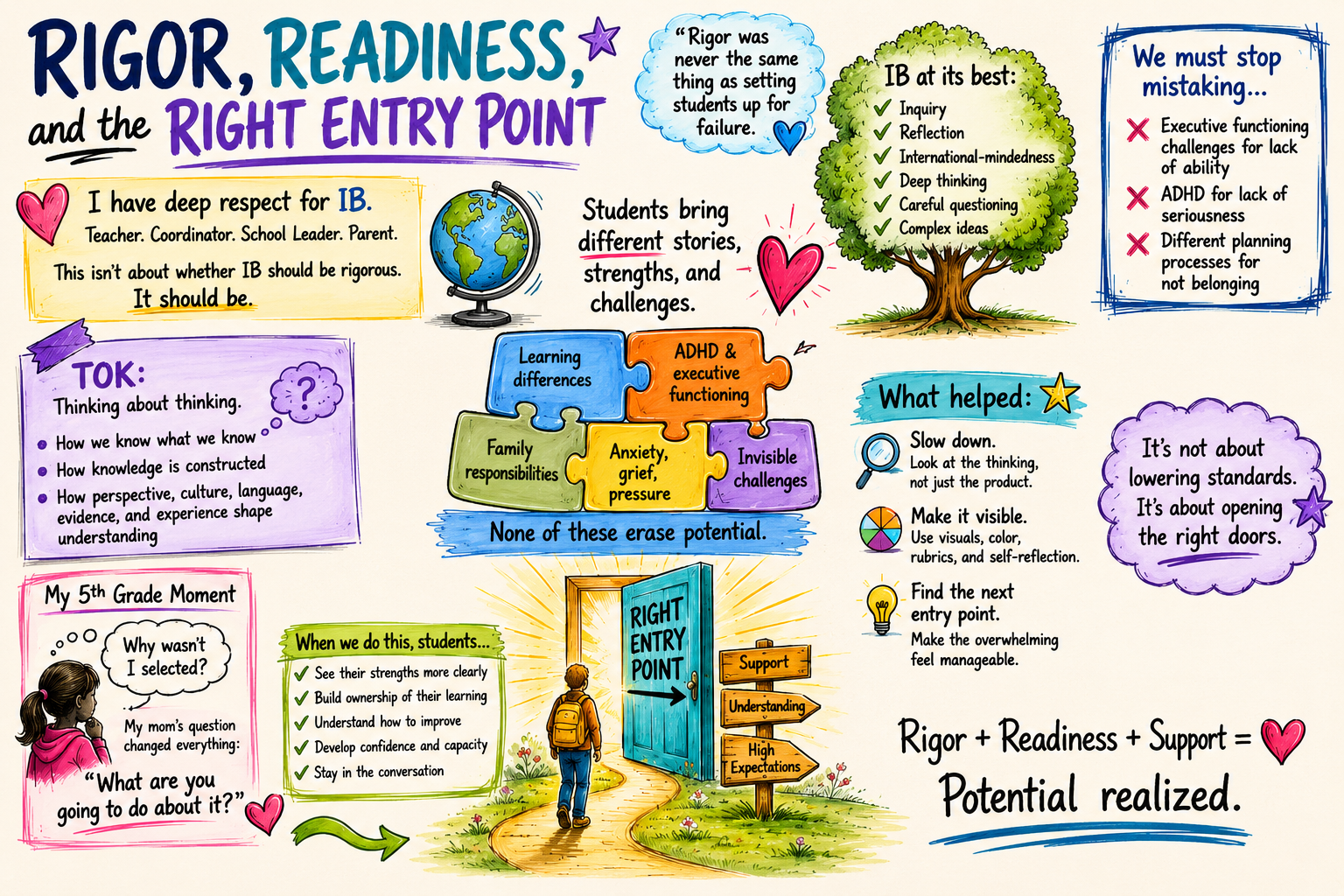
I want to be clear from the start: I have too much respect for the International Baccalaureate program to reduce this conversation to a critique. I have been connected to IB for many years as a teacher, coordinator, school leader, and parent. My daughter moved through the program from the Primary Years Programme all the way to the Diploma Programme. My appreciation for IB is personal, professional, and deeply rooted in lived experience. That context matters, because what I want to talk about is not whether IB should be rigorous. It should be. What I want to talk about is how adults understand readiness, potential, and support.
I believe in inquiry. I believe in reflection. I believe in international-mindedness. I believe in asking students to think deeply, question carefully, and engage with complex ideas. One of the parts of IB I have always valued most is Theory of Knowledge, also known as TOK.
When I was first asked to teach TOK in 2010, I did not fully know what I was stepping into. I had no idea how quickly I would need to learn the course, the language, the expectations, and the philosophy behind it. But I immersed myself in it, and I came to see TOK as one of the signature pieces of the Diploma Programme. It asks students to think about thinking, to question how they know what they know, how knowledge is constructed, and how perspective, culture, language, evidence, and experience shape understanding. Because I valued the course, I taught it with rigor. I expected students to read, prepare, participate, and engage with ideas in ways that stretched them.
But rigor was never the same thing as setting students up for failure. That distinction matters.
I have worked with students in public school settings who brought a wide range of academic, social, emotional, and life experiences into the classroom. Some had strong support systems. Some did not. Some were navigating challenges that were invisible to others, managing learning differences, executive functioning demands, family responsibilities, anxiety, grief, or pressure that had nothing to do with their potential but everything to do with how they showed up on a given day.
This is about what happens when executive functioning challenges are mistaken for lack of ability, when ADHD is mistaken for lack of seriousness, or when a student's need for a different planning process is mistaken for evidence that they do not belong.
What Are You Going to Do About It?
Part of why this matters so deeply to me is because I remember being on the other side of that kind of belief as a child. In 5th grade, certain students were selected for the gifted and talented program. Some of my friends were chosen, and I was not. I went home upset and told my mother what had happened. Instead of trying to fix it for me, she asked a question that has stayed with me: “What are you going to do about it?”
I told her I was going to talk to Mrs. Phillips because I did not think it was fair. I knew I was just as smart as my friends who had been selected. I also knew I had problems with math sometimes, but I did not believe that should erase everything else I was capable of doing.
Looking back, that was one of my earliest experiences with the question of who gets selected, who gets seen, and who gets invited into certain academic spaces. I did not have the language then for executive functioning, learning differences, or gatekeeping, but I knew something about it felt incomplete.
Readiness Arrives in Many Forms
Many of us were trained to recognize readiness in familiar forms: organized notes, quick verbal responses, polished outlines, independent follow-through. Those skills matter. But they do not capture every student's capacity.
A student may have strong ideas and still need help organizing them. A student may understand the text and still need support translating that understanding into structure. A student may think deeply but process visually, needing to talk, draw, map, or externalize their thinking before they can write. Too often, those students are underestimated.
Recently, I returned to IB work by proxy through tutoring and coaching. After years in the classroom and in school leadership, I saw an opportunity to continue supporting students in a program I respect, without carrying the full weight of classroom instruction and administration.
The Essay as a Thinking Product
The work began with IB English. I was supporting a student with an essay, and instead of starting with the assumption that the writing was the problem, we slowed down and looked at the essay as a thinking product. The question was not simply, “Is this good or bad?” It became: “Can the student see what the essay is doing?”
We used a visual self-evaluation process to help him step back and view the essay from the outside. Using the rubric as a mirror, we examined the major expectations of the assignment, including knowledge and understanding, interpretation, analysis, organization, development, and language, then used digital tools like highlighting, comments, and a self-score table to make the essay's structure visible.
Color became a way to reduce the noise. One color marked strong analysis. Another flagged where the essay drifted into summary. Another identified evidence that needed more explanation. The point was not to decorate the essay. It was to help the student see its patterns. That visual process transformed revision from an overwhelming command to “make this better” into a more manageable question: “Where is the next entry point?”
TOK and the Shift From Description to Analysis
That same approach carried into TOK. The student had a Theory of Knowledge exhibition that had already received teacher feedback. The original direction was not fully aligned with the objects he had chosen, so the teacher suggested a different prompt that better matched his thinking. Rather than treating that as a sign the work was wrong, we treated it as data.
We slowed down and asked: What is already working? What thinking is worth keeping? What needs to be reframed so the exhibition better answers the new prompt?
The work became less about rewriting from scratch and more about helping him see the relationship between his chosen objects, the prompt, and the larger question of how knowledge is produced or acquired. We looked at each section and asked whether the writing was describing the object or explaining the object's role in the knowledge process. That distinction moved him from summary to analysis.
We also built complexity into the essay. Once he could identify the main claim connected to each object, we explored possible counterclaims. Could a tool support knowledge acquisition but still have limitations? Could access to information exist without true understanding? These questions deepened the analysis without abandoning his original ideas.
From an executive functioning perspective, the assignment carried significant cognitive load: shifting prompts, holding abstract TOK concepts in mind, deciding what was still relevant, revising what was not aligned, and managing the emotional weight of teacher feedback and a deadline.
It quickly became clear that this student was capable. He had read the texts. He understood the assignments. He could talk through the ideas. His only real barrier was the executive functioning demand of getting from understanding to written structure.
The Moment That Clicked
After a couple of sessions, his mother shared that he has ADHD and that he feels embarrassed about it. Something clicked for me at that moment. When I had introduced myself as a coach, he may have wondered whether I already knew, whether his diagnosis had been shared before we met. It had not. The connection was coincidental, but it was revealing. Here was a student who had internalized discomfort around ADHD, yet the work in front of me told a different story. He was thoughtful. He was prepared. He understood far more than he may have realized. His challenge was not intelligence, and it was not effort. It was executive functioning.
This is one of the reasons I believe expressive arts and executive functioning support belong in conversations about rigorous academic programs. The work is not about making art for art's sake. It is about using visual structure, color, mapping, and externalization to help students organize what is already in their minds, to stop holding the entire assignment in their heads at once, and move from “I have to fix all of this” to “I know the next revision move.”
Academic writing struggles are not always writing problems. Sometimes the student has strong ideas but needs help externalizing the structure, clarifying the question, and seeing how each part of the draft should serve the larger argument. Coaching helped this student move from description to analysis, from confusion to alignment, and from teacher feedback as criticism to teacher feedback as a roadmap.
Multiple Ways In
In IB, we talk about inquiry, reflection, perspective, and multiple ways of knowing. That same spirit can shape how we support learners. If we believe knowledge can be constructed, examined, and expressed in multiple ways, then we can also recognize that students may need multiple pathways into complex tasks.
The question should not be, “Does this student belong in a rigorous program?” The better question is: “What support, structure, and entry point allows this student to access the rigor that is already within reach?”
That shift matters. Students do not need us to lower the bar. They need us to examine whether we have built only one kind of ladder.
A student who struggles to start may still be deeply capable. A student who cannot organize their thoughts in a traditional way may still have complex, nuanced ideas. A student with ADHD may need scaffolding, but scaffolding is not the same as lowering expectations. The right scaffold can be exactly what allows the student to finally reach the expectation.
I still believe in the power of IB. I still believe in TOK. I still believe in asking students to think deeply, read carefully, question thoughtfully, and communicate clearly. But I also believe we have to be honest about how students get there. For some, the path to a strong essay begins with a conversation. For others, it begins with a visual map, or with naming the overwhelm, regulating the nervous system, and building a plan that makes the assignment feel possible. The planning may happen in colors before it becomes paragraphs. The structure may appear as images before it becomes an outline.
And there is nothing wrong with that.
Potential does not always announce itself in familiar packaging. Sometimes it arrives scattered. Sometimes it arrives overwhelmed. Sometimes it arrives embarrassed by a diagnosis, or needing a different kind of first step. Our job is not to decide too quickly who belongs. Our job is to believe long enough, observe closely enough, and support skillfully enough to help students find their way in.
Because when we tap in, listen closely, and find the right entry point, students often show us that they were never incapable.
They were waiting for a way in.