August 2026
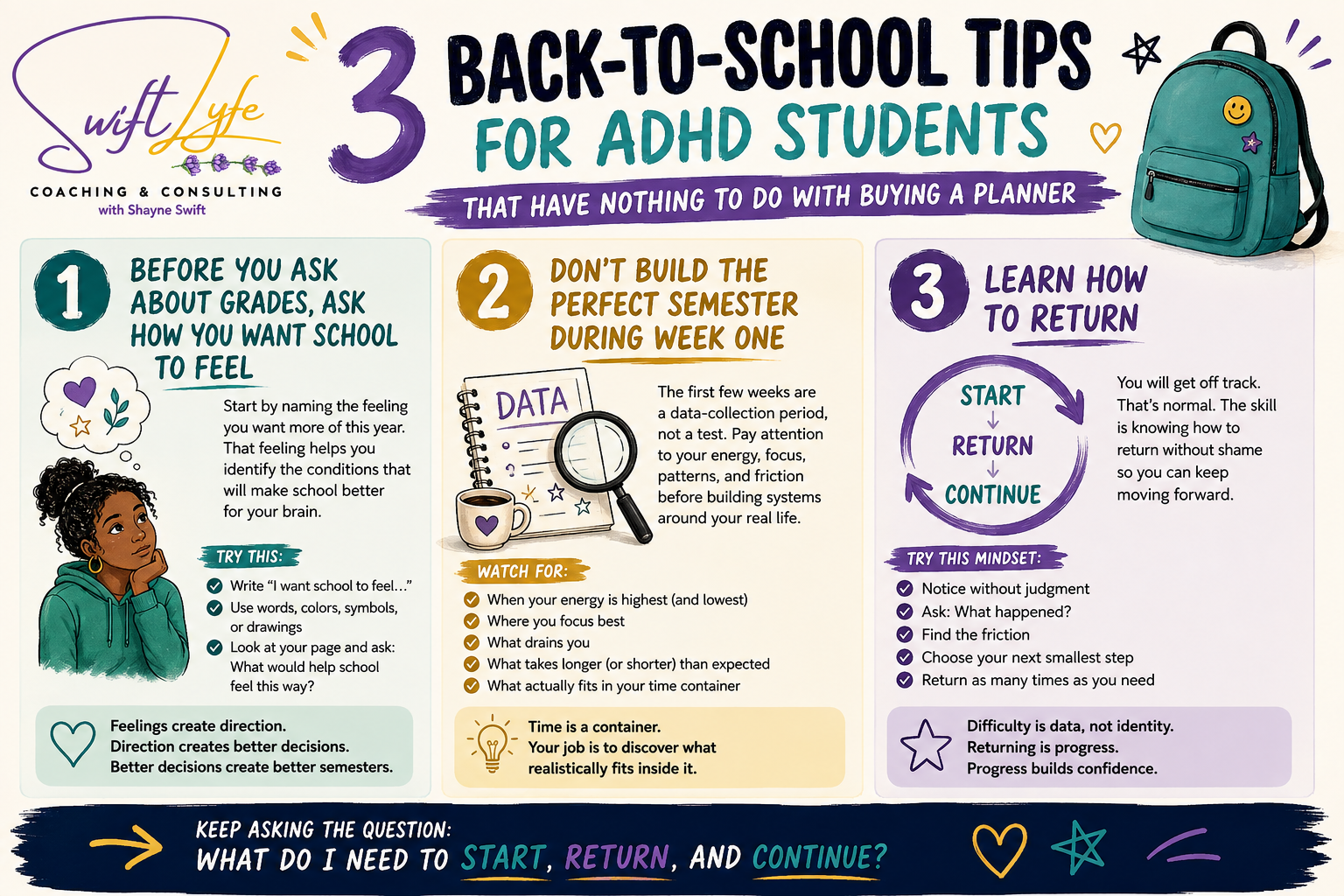
3 Back-to-School Tips for ADHD Students That Have Nothing to Do With Buying a Planner
Back-to-school season comes with a lot of advice. Get organized. Use a planner. Make a schedule. Don't procrastinate. Start your assignments early. Stay on top of your work.
All useful ideas.
And also? If those instructions were enough, many of the ADHD students I coach wouldn't need coaching.
As I've been working with my high school and college students to prepare for another school year, I've noticed that our conversations aren't really about planners or school supplies. We're talking about energy. We're talking about what happens when you have three classes back-to-back and still need to do homework. We're talking about whether adding another extracurricular activity is actually realistic. We're talking about sleep, transitions, distractions, independence, and what happens when the schedule we carefully created doesn't work.
Most importantly, we're talking about the difference between having time and having the capacity to use that time.
So, if you're an ADHD student—or you love, teach, parent, or support one—there are three things I think are worth focusing on as we head back to school.
1. Before You Ask About Grades, Ask How You Want School to Feel
One of the expressive arts activities I've been using with students asks a deceptively simple question: What do you want school to feel like?
Not, “What GPA do you want?” Not, “How many A's are you going to get?” Not even, “What are your goals this semester?”
Instead, I ask students to imagine themselves walking into school at the beginning of the day. Then I ask them to imagine an ordinary Tuesday in October or November, after the excitement of the new school year has worn off. Finally, I ask them to picture themselves sitting down to do homework.
How do they want those moments to feel?
Maybe they want to feel calm, confident, prepared, connected, independent, interested, or challenged without constantly feeling overwhelmed. Maybe they simply want school to feel less chaotic than it did last year.
Once we identify the feeling, we can start asking better questions.
- If you want school to feel less rushed, what needs to happen in the morning?
- If you want homework to feel manageable, what environment helps your brain start?
- If you want to feel more independent, what responsibilities do you need to begin owning instead of waiting for someone else to remind you?
- If you want to feel connected, where are your people?
- If you want to feel rested, what needs to happen at 10:00 p.m., not just at 7:00 a.m.?
Now we're getting somewhere.
We're moving away from an abstract goal like “have a good semester” and beginning to identify the actual conditions that might help create one.
Students can try this with nothing more than a blank piece of paper. Write “I want school to feel…” at the top. Add words, colors, symbols, lines, drawings—whatever comes naturally. This isn't an art project that needs to look good. It is a way to make something internal visible.
Then look at the page and ask: What would help school feel this way?
That is a very different place from which to begin back-to-school planning.
2. Don't Build the Perfect Semester During Week One
I love a fresh start, and ADHD brains often love them too.
New notebooks. New apps. New schedules. New routines. Suddenly, this is the semester when we're going to wake up at 6:00 every morning, study for two hours every afternoon, exercise five days a week, keep the room clean, join three clubs, answer every email immediately, and somehow remember to drink enough water.
Then October arrives.
The problem isn't necessarily that the student failed. The problem may be that we created an entire system before we had enough data.
A schedule can show a college student that they have two hours available between classes, but that doesn't automatically mean they have two hours available for focused academic work. After three morning classes, their brain may be exhausted. They may need lunch first. They may need movement. A 20-minute nap might restore enough energy to work, or that 20-minute nap might turn into three hours and teach us that napping isn't the right strategy.
The library may turn out to be the perfect place to work. Their dorm room may turn out to be where productivity goes to die.
We don't know yet.
That is why I want students to think about the first couple of weeks of school as a data-collection period, not a test of whether they can finally “get it together.”
- Pay attention to when it is easiest to start.
- Notice when your energy drops.
- Observe where you focus best.
- Pay attention to which assignments you avoid and what happens right before you get distracted.
- Notice when your phone becomes a problem.
- Which classes require more energy than you expected?
- How long does homework actually take?
- When do you need food, movement, quiet, connection, or recovery?
This is where one of the phrases I use often with clients becomes especially important:
Time is a container.
Your calendar can tell you that the container exists, but we still have to figure out what realistically fits inside it. That matters for college students navigating increased independence, and it matters for high school students whose schedules are becoming more complicated with harder classes, sports, clubs, jobs, friendships, family responsibilities, and everything else they are trying to hold.
An empty space on a calendar does not automatically equal available capacity.
So don't fill every container yet. Experience your life first. Pay attention to your brain and your body. Then begin building systems around the life you are actually living rather than the imaginary perfectly productive version of yourself you created before school started.
3. Learn How to Return
This may be the most important back-to-school skill of all.
At some point this school year, the system is probably going to fall apart.
That isn't pessimism. I want to remove some of the shame before it happens.
A student may miss an assignment. They may ignore the planner for nine days. They may stay up until 3:00 a.m. They may forget an appointment, spend an afternoon scrolling when they intended to study, choose something fun when they really needed to finish an assignment, or avoid responding to a parent, teacher, professor, or coach because they didn't do the thing they said they were going to do.
They may have a spectacularly organized September and a completely chaotic October.
None of that tells me who that student is.
It gives us data.
Difficulty is data, not identity.
- “Here I go again”We can ask: “What happened?”
- “I'm so lazy”We can ask: “Where was the friction?”
- “I ruined my whole schedule”We can ask: “What would help me return?”
This is why I talk with my students about Start → Return → Continue.
We spend a lot of time teaching students how to start. Starting absolutely matters, especially for an ADHD brain. But returning is an executive function skill too.
- You were working and picked up your phone. Notice. Return.
- You stopped using your planner. Notice. Return.
- You missed three days of the study routine. Notice. Return.
- You fell behind in the reading. Notice where you actually are now. Then return.
The goal is not to create a student who never gets off track. That isn't realistic for most humans, ADHD or otherwise.
The goal is to help create a student who knows what to do when they realize they are off track.
Parents can play an enormous role here. When your student gets off track, it can be tempting to immediately point out that you warned them this would happen. But there is much more executive function learning available if we become curious instead.
What happened? Where did the plan stop working? What made it difficult to return? What do you need now? What is the next smallest step?
That isn't removing accountability. It is helping a young person develop the ability to recover.
And recovery is something they are going to need long after graduation.
A Different Kind of Back-to-School Goal
Maybe this year success doesn't have to mean, “I stayed organized all semester.”
Maybe success can mean, “I understood myself better in December than I did in August.”
Maybe the student learned when their brain works best. Maybe they discovered which environments help them focus. Maybe they recognized when they were taking on too much. Maybe they asked for help sooner instead of waiting until everything became urgent. Maybe they learned that accommodations are tools rather than evidence that they aren't capable. Maybe they became better at noticing when they were drifting away from what mattered.
And maybe they stopped turning every difficult moment into evidence that something was wrong with them.
For me, that is what back-to-school executive function work is really about. We are not trying to manufacture perfectly organized students who never procrastinate, forget, become overwhelmed, or lose momentum.
We are helping young people become increasingly able to understand their own brains, recognize what they need, make adjustments, and begin again.
So as we head into another school year, three places to begin: think about how you want school to feel, treat the beginning of the semester as an experiment, and learn how to return when things don't go according to plan.
Then keep asking one question:
What do I need to Start, Return, and Continue?
That sounds like a pretty successful school year to me.
Free Download · No Pressure
ADHD Clarity Starter Guide
A 35-page, shame-free guide to understanding your ADHD—with practical strategies and one small next step to take this week. Completely free.
Get the Free Guide →Supporting an ADHD Student This Year?
Whether you're a student, parent, or educator — let's talk about building a school year that works with your brain, not against it.
Book a Free Call