Two years ago today, I walked out of Girls Global Academy for the last time.
People often ask me what it was like to leave education. The truth is, that's not what it felt like. I wasn't just leaving a school. I was leaving something I had helped build. As a cofounder, Girls Global Academy wasn't simply a place where I worked. It felt like leaving a child I had helped raise and a family I had grown to love. I had poured years of my life into its students, its educators, its culture, and its vision. The people there were more than colleagues. They were family.
Walking away wasn't an act of dissatisfaction. It was an act of faith. One of the hardest acts of faith I have ever taken.
There is a particular kind of grief that comes with leaving something you love, even when you are walking toward something you also love. Both can be true. I grieved the daily rhythm of the school, the conversations in the hallway, the students whose lives I had the privilege to witness over the years, the educators who challenged and inspired me, and the mission we had built together.
At the same time, I felt an undeniable pull toward another mission. I wanted to create a space where people with ADHD could stop believing they were lazy, broken, or simply not trying hard enough. I believed there had to be another way. So I stepped into entrepreneurship.
And honestly, I thought the hardest part would be learning how to run a business.
I was wrong.
Over the past two years, I've discovered that entrepreneurship is not primarily a knowledge problem. For many of us, especially those of us with ADHD, it is an executive functioning challenge.
No one tells you about the cognitive load of running a business. They tell you about marketing, branding, websites, and social media. What they don't tell you is that every day you'll be asked to become the CEO, the practitioner, the marketer, the accountant, the administrator, the strategist, the content creator, and the visionary — sometimes before lunch. They don't tell you how many decisions you'll make in a single day or how much energy it takes to hold dozens of open loops in your mind while trying to serve people well. They don't tell you how lonely it can feel.
Coaching school taught me how to coach. It did not teach me how to build systems, choose software, create onboarding processes, manage a CRM, write policies, organize client notes, file business taxes, evaluate whether someone is the right client, or build a sustainable business. I learned those lessons through trial and error, mentors, books, rabbit holes, countless conversations, and more than a few mistakes. Then I made different mistakes.
Some of my hardest lessons had nothing to do with business operations. They had everything to do with people.
Despite already knowing that mixing friendship and business could become complicated, I did it anyway. Sometimes it worked. Sometimes it didn't. What I learned is that friendship alone doesn't make someone the right business partner. Shared values, communication, accountability, and expectations matter just as much.
I also learned that not everyone will understand your vision. That's one of the hardest lessons for any entrepreneur. When you can already see what you're building, it's easy to assume others can see it too. Often they can't. Not because they don't care, but because the vision hasn't become visible yet.
Perhaps one of the most important lessons I've learned is the difference between a critical friend and someone who is simply critical.
Critical friends ask difficult questions because they want you to grow. They challenge your thinking without diminishing your confidence. They refine the vision. People who are simply critical leave you questioning yourself more than your strategy. They point out problems without helping you move forward. Learning whose voices deserve a seat at my table has become one of the greatest acts of leadership and self-trust I've developed over these past two years.
As I coach more entrepreneurs through ADHD CEO Business Builders, something became unmistakably clear. Most of the entrepreneurs I worked with didn't lack intelligence. They didn't lack talent. They didn't even lack motivation. They lacked systems that supported the extraordinary executive functioning demands of entrepreneurship.
That realization changed everything.
I stopped asking, “How can I help people become more productive?” Instead, I started asking, “What is your brain carrying?”
Because the problem usually isn't capability.
It's cognitive load.
Entrepreneurship may be one of the most executive function intensive paths a person can choose. Every day demands planning, prioritizing, task initiation, working memory, emotional regulation, cognitive flexibility, decision making, sustained attention, resilience, and goal-directed persistence. Most business advice focuses on strategy. Very little addresses the brain that has to carry that strategy every single day.
I've come to believe that sustainable entrepreneurship isn't built on willpower. It's built on systems, energy, and self-trust.
Systems are kinder than willpower because they reduce cognitive load. They remember what your brain shouldn't have to. They preserve energy for the work that matters most.
I've also learned that my nervous system is one of my greatest business assets. For years I believed rest came after productivity. Entrepreneurship taught me the opposite. The state of my nervous system directly influences my ability to plan, solve problems, make decisions, regulate emotions, and think creatively. When my nervous system is overwhelmed, my executive functions struggle. When it feels supported, my thinking expands.
Ironically, one of my greatest teachers wasn't another business course.
It was creativity.
When the demands of entrepreneurship became heavy, I found myself creating generative art in Midjourney. At first I thought I had found a fascinating new creative outlet. Looking back, I realize I had discovered a way to regulate my nervous system.
Every prompt required me to clarify a vision. Every revision strengthened my cognitive flexibility. Every unexpected result taught me that iteration is not failure. Every completed image reminded me that something beautiful can emerge from uncertainty.
Without realizing it, I was strengthening many of the executive functions I coach every day: planning, emotional regulation, resilience, goal-directed persistence, flexible thinking, and the ability to return after frustration.
Creating also became an act of unmasking.
For years I had been known as the educator, the instructional leader, the curriculum writer, and the coach. Somewhere along the way I had quietly tucked away the artist. Midjourney invited me to reconnect with that part of myself. Not because it was productive. Not because it generated revenue. Simply because it made me feel whole.
It also became a practice of manifestation.
Every image began as something invisible — an idea that existed only in my imagination. Prompt by prompt and revision by revision, that invisible idea became something tangible.
Entrepreneurship has felt remarkably similar.
You begin with a vision that no one else can see. You keep believing in it long before there is evidence. You revise. You pivot. You learn. You return. Eventually, what once existed only in your imagination begins to exist in the world.
Looking back, I realize I didn't leave education two years ago.
I simply found a different classroom.
Today my classroom looks different. Sometimes it's a coaching session. Sometimes it's a workshop. Sometimes it's an ADHD CEO Business Builders conversation. Sometimes it's an entrepreneur trying to build a business that fits their brain. Sometimes it's an adult hearing, perhaps for the first time, that they are not lazy, they are not broken, and they are not failing.
The mission never changed.
The setting did.
Today begins year three of SwiftLyfe Coaching & Consulting. I know there will be more lessons, more pivots, more mistakes, and more growth. I welcome all of it because these past two years have taught me that building a business with ADHD isn't about becoming someone else. It's about building systems that support who you already are. It's about protecting your energy, trusting your brain, creating with intention, surrounding yourself with people who strengthen your vision, and returning after setbacks with curiosity instead of shame.
The business I have built matters.
The person I have become while building it matters even more.
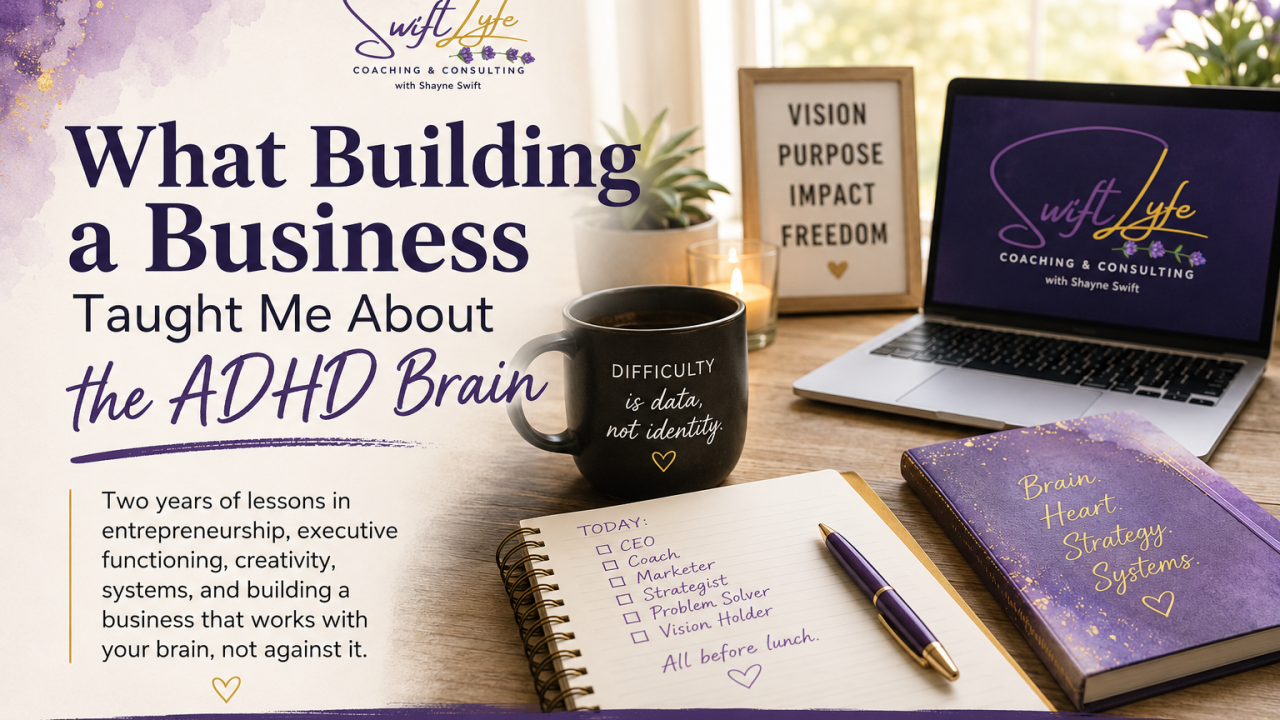
Because difficulty is data, not identity.
Free Download · No Pressure
ADHD Clarity Starter Guide
A 35-page, shame-free guide to understanding your ADHD—with practical strategies and one small next step to take this week. Completely free.
Get the Free Guide →Ready to Build Systems That Support Your Brain?
If you're an entrepreneur with ADHD carrying too much cognitive load, let's work together to lighten it — and build from your strengths.
Book a Free Call